
What Is ODRC?
ODRC is the Ohio Department of Rehabilitation and Correction. The agency operates Ohio's adult state-prison system, manages institution operations, supports reentry, and oversees parole and post-release-control supervision through the Adult Parole Authority. ODRC is not a sheriff's office and does not run the county jail roster after a new arrest. Its public search role is the statewide prison and supervision layer.
The research confirms ODRC as the safer public-facing abbreviation because the agency uses it across offender search, facility, report, annual-report, and policy materials. Older or policy shorthand may use DRC, but this page uses ODRC for the title, H1, URL, headings, and body because that is how the current public web structure labels the department.
The ODRC Offender Search identifies the Ohio Department of Rehabilitation and Correction and provides the official search form.
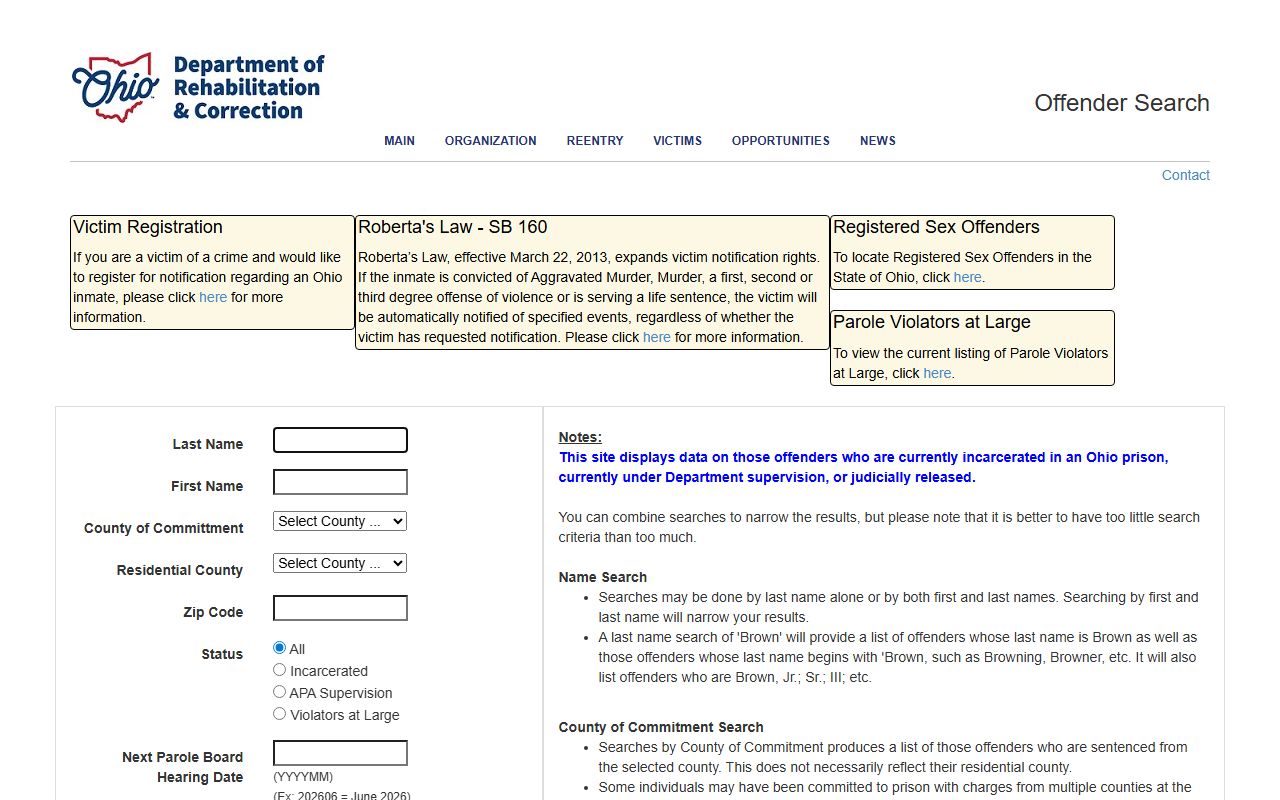
The search form is the practical starting point when a person has moved from local jail custody into the Ohio state-prison or supervision system.
The ODRC Inmate Population
The best exact accessible count in the research is 45,704 total institutional population as of January 6, 2026, in an ODRC monthly population count screen-reader report. The December 2025 count-by-institution report showed 45,833 total in search-index text. ODRC figures cited for July 1, 2025 and September 3, 2025 were 45,466 and 45,454. Together, those figures support a modest-growth or broadly stable trend through early 2026.
| Measure | Figure | Source note |
|---|---|---|
| ODRC inmate population | 45,704 | January 6, 2026 monthly population count |
| December 2025 total | 45,833 | ODRC count-by-institution report text |
| July 1, 2025 count | 45,466 | ODRC monthly trend cited in research |
| September 3, 2025 count | 45,454 | ODRC monthly trend cited in research |
How to Search ODRC Inmate Locator
ODRC states that its Offender Search displays people currently incarcerated in an Ohio prison, currently under Department supervision, or judicially released. It is broader than a prison-only list but narrower than every Ohio custody record. County jail inmates, city jail detainees, federal inmates, and civil immigration detainees may be outside ODRC even when their case started in Ohio.
- Search by ODRC number when known. ODRC says the number uses A, R, or W prefixes, with W used for female inmates and A or R for male inmates.
- Use six digits with no spaces or hyphens. Add a leading zero if a female offender number has five digits.
- When the number is unknown, search by last name first because ODRC warns that too many fields can miss records.
- Use County of Commitment for the sentencing county, not for the current home county or arrest county.
- Use Residential County or ZIP for APA Supervision or Violators at Large because that field reflects last recorded address data.
ODRC status options documented in the research include All, Incarcerated, Released, APA Supervision, and Violators at Large. The next Parole Board hearing month uses YYYYMM format, such as 202607 for July 2026. If no result appears, check the county jail roster, court docket, BOP, ICE, and VINELink before assuming the person is not in custody.
What an ODRC Record Shows
An ODRC profile is meant to identify state-prison and supervision status. Exact result fields can vary, but the research supports a consistent explanation of what users are trying to confirm: identity, ODRC number, current status, institution or supervision status, commitment county, next parole-board hearing information when applicable, and release or supervision signals.
| Field | What it helps confirm |
|---|---|
| ODRC number | The state identifier used to distinguish people with similar names. |
| Status | Whether the person is incarcerated, released, under APA supervision, or listed in another ODRC status. |
| Institution or supervision record | The current prison, supervision status, or related ODRC placement signal. |
| County of commitment | The Ohio county tied to the sentence, which may differ from residence or arrest county. |
| Parole-board hearing month | A hearing month if the person has a listed Parole Board setting. |
The locator is not a statewide warrant search, mugshot gallery, full criminal-history report, or county jail intake list. Those records live in other systems.
ODRC Prisons and Facilities
ODRC's institution system is statewide. The research identifies North, South, and Specialty regions and lists institution codes for Allen-Oakwood, Belmont, Chillicothe, Franklin Medical Center, Correctional Reception Center, Dayton, Grafton, Lake Erie, Lebanon, London, Lorain, Madison, Mansfield, Marion, North Central Correctional Complex, Noble, Northeast Ohio Correctional Center, Northeast Reintegration Center, Ohio Reformatory for Women, Ohio State Penitentiary, Pickaway, Ross, Richland, Southeastern, Southern Ohio, Trumbull, Toledo, and Warren.
The ODRC facilities page organizes those prisons as an agency-wide institution directory.
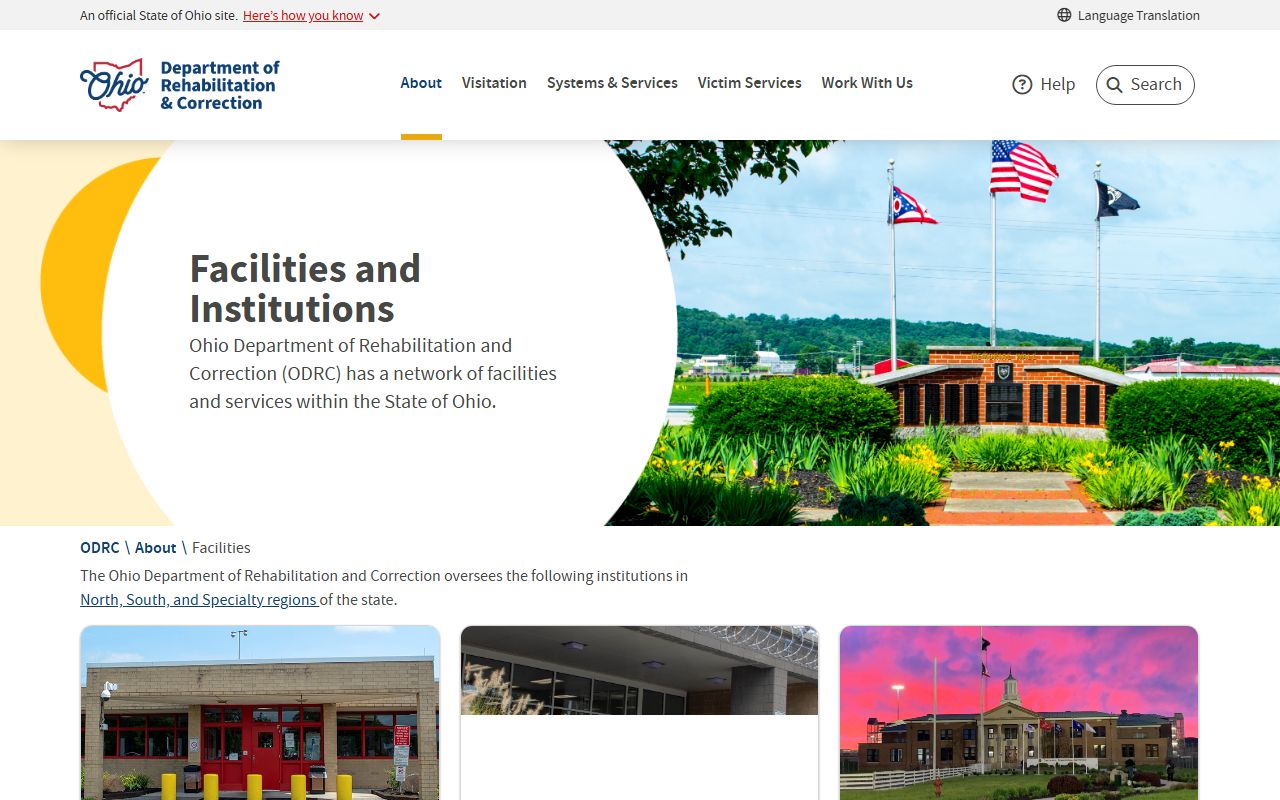
That directory helps separate prison searches from county jail searches, especially when a prison sits inside a county with its own sheriff-run jail.
ODRC reporting uses security categories 1, 2, 3/3R, 4, E, ET, and death row. Level 1 is the lowest general-population security level. Level 2 is a mid-range general-population level. Level 3/3R reflects higher custody or restricted and reentry variants. Level 4 and above are high security. E and ET are extraordinary or high-control levels tied to restrictive management and transition. Death row is reported separately as D.ROW.
ODRC Sentencing and Release
Ohio's release framework mixes older parole-eligible indefinite sentences, life sentences, Reagan Tokes non-life felony indefinite terms, definite prison terms, judicial release, transitional control, earned credit, and post-release control. ORC 2967.13 addresses parole eligibility for older, life, and indefinite terms. ORC 2967.271 creates a presumptive release process for certain non-life felony indefinite terms unless ODRC rebuts the presumption under statutory grounds.
Post-release control is supervision after prison release and is governed by ORC 2967.28. ODRC's Adult Parole Authority manages release transition and post-release supervision, while the Ohio Parole Board conducts release-consideration hearings for parole-eligible people. Transitional control is a structured program for eligible people during the final 180 days before release, subject to screening and board approval.
The Ohio Attorney General victim-notification page explains custody-status notification options for victims and concerned citizens.
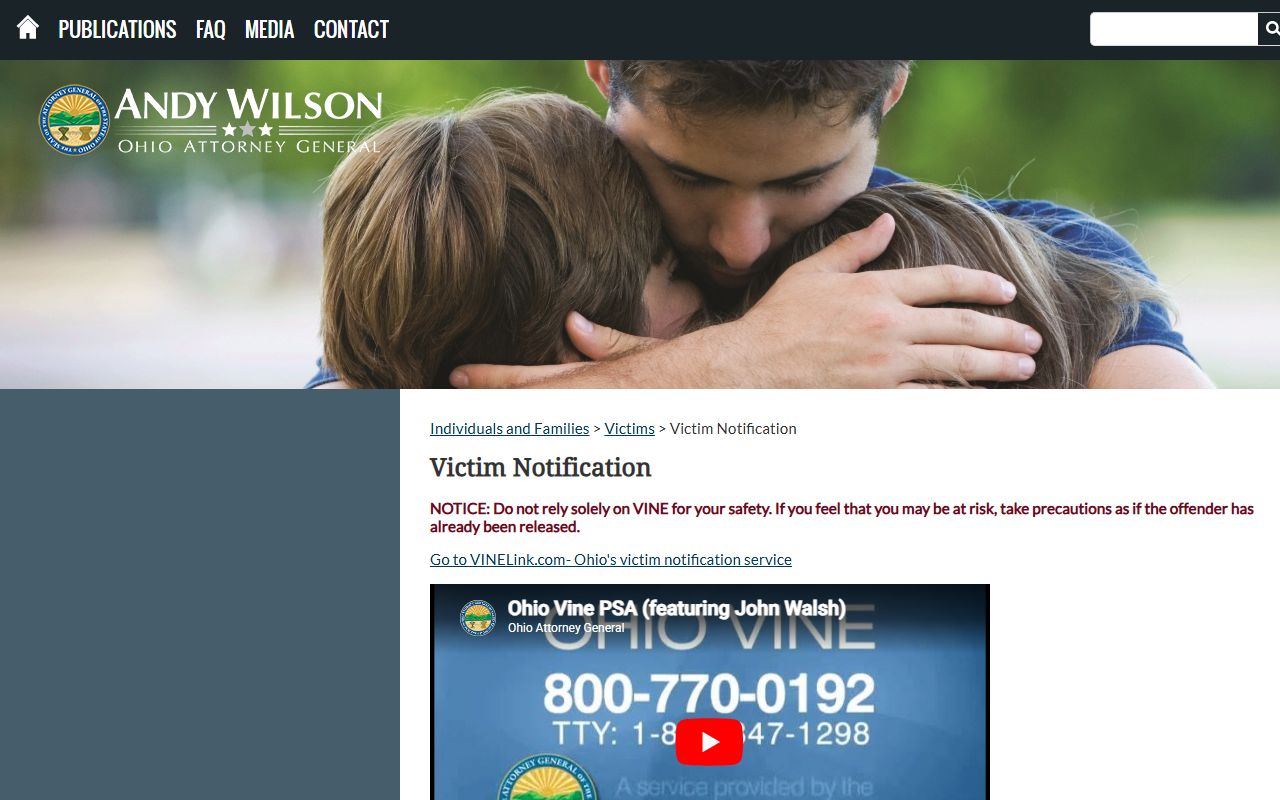
Notification tools can help with custody changes, but they do not replace the ODRC record or the sentencing court docket.
Earned credit should be described with care. ORC 2967.194 is the current earned-credit statute for confinement on or after April 4, 2024, while ORC 2967.193 contains older and transition language. OAC 5120-2-06 implements credit rules, exclusions, and program-completion credits. Ohio does not allow a simple promise that every prisoner receives the same reduction. The sentence, offense, date, eligibility, and program record all matter.
ODRC Records Requests
ODRC records requests should be specific. The research points to ODRC public-records policy 07-ORD-02 and Ohio's public-records framework. Useful requests identify the person, ODRC number, institution, date range, and record type. Requests for medical records, education records, PREA records, security footage, juvenile records, and sealed records may require additional authority or may be withheld or redacted.
ORC 149.43 is the general Ohio public-records law. ORC 5120.21 creates ODRC inmate-record limits while allowing disclosure of some basic information, including name, identifying information, photograph, convictions, supervision status, current and past place of incarceration, and disciplinary history. A broad request for everything about an inmate is more likely to be narrowed, delayed, redacted, or denied.
The most useful ODRC request states whether the user needs a locator confirmation, institutional record, sentence or release document, disciplinary history, visiting or mail record, or policy record. The request should avoid asking a prison to answer court questions that belong to the sentencing court. Motions for judicial release, sentencing entries, revocation orders, and case dispositions are court records, even when the outcome changes the ODRC record later.
The Ohio Public Records Act page supplies the statewide records framework used for ODRC and local agency requests.
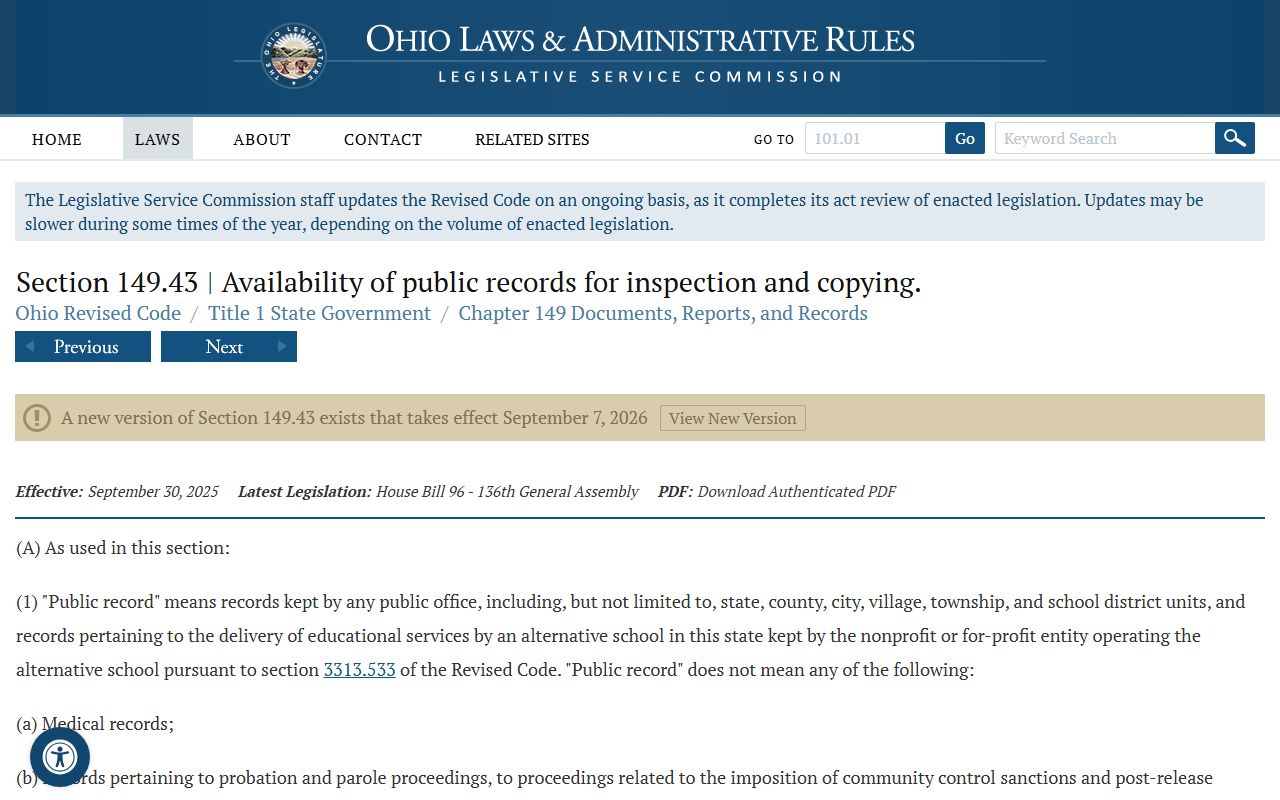
For local booking records, the request goes to the sheriff, regional jail, or city facility, not to ODRC.
ODRC vs County Jail
ODRC is the state-prison and supervision search path. County jail rosters are the arrest, booking, pretrial, and short-sentence search path. Regional jails can serve several counties. Municipal jails may hold people for a short period or route them to a county or regional jail. A person can move between these layers quickly, so a search should follow the custody event rather than just the county name.
| ODRC | County or regional jail | |
|---|---|---|
| Custody type | Sentenced state prisoners and supervision records | Fresh arrests, pretrial custody, short local sentences |
| Search tool | ODRC Offender Search | County or regional jail roster |
| Case source | Sentencing court docket plus ODRC record | Booking record plus local court docket |
This distinction is the main ODRC inmate population rule. The arrest county, commitment county, current prison county, and residential county can all be different. ODRC warns that County of Commitment does not necessarily equal residential county, and a residential search for APA supervision or violator-at-large status uses the last recorded address. Searchers should read those fields as record clues, not as proof of current physical location unless the profile says so.
ODRC Inmate Population FAQ
What is the ODRC inmate population?
It is the state-prison institutional population reported by the Ohio Department of Rehabilitation and Correction. The best exact accessible count in the research is 45,704 people as of January 6, 2026.
Does ODRC show county jail inmates?
No. ODRC search covers Ohio prison custody and several supervision or release statuses. Fresh arrests and pretrial jail custody are searched through the county or regional jail roster.
What if the ODRC search has no result?
Check the county jail roster, local court docket, BOP, ICE, and VINELink. A non-result in ODRC does not prove the person is not in another custody system.
Public Record Search
Sponsored Results